
A digital business card built for researchers.
One link with your affiliation, your lab, your office hours link, and your publications, pulled straight from ORCID. Free, and no app for anyone to download.

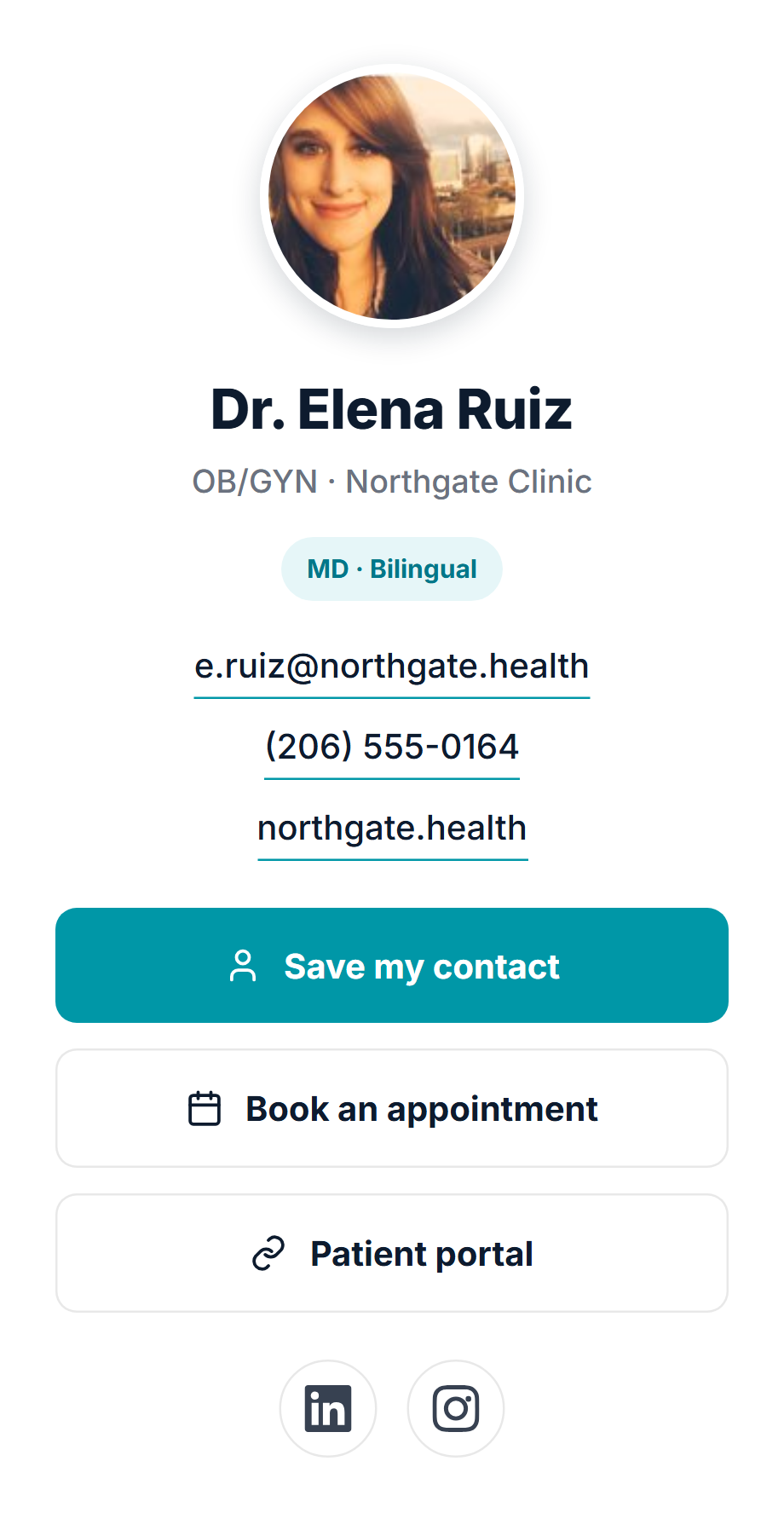
Why researchers switch
Your paper card goes stale every time you move.
A new institution, the end of a postdoc, a different lab, academia moves, and a box of printed cards doesn't. A digital card is one link that's always current. Edit it once and everyone who saved you sees the new affiliation, not the old one.
Build it in minutes
Name, affiliation, lab, ORCID iD, photo. No account needed to start.
Share a link or QR
At poster sessions, in your email signature, or on a conference slide. Anyone can scan it, no app.
They save you in one tap
Colleagues and collaborators add you to their contacts in one tap, current forever.
Publications, automatic
Your papers, on your card, pulled from ORCID.
Most academics already have an ORCID iD. Add yours and your publications show up on your card automatically. Publish something new and the card picks it up. No other card maker does this, and it's in the free tier.
ORCID publications
Your papers, listed and current, without copy-pasting citations. Unique to this card.
Lab & office links
Point people at your lab page or your office hours link, one clean link for each.
Profile links
Google Scholar, LinkedIn, your lab page, all your profiles in one place.
Save to contacts
One tap adds you to a colleague's phone, name, email, phone, links.
QR for your poster
Print your QR on the poster corner. It also rides in Apple or Google Wallet.
Edit anytime
New institution? Update once, the same link stays right everywhere it's already saved.
Where it earns its keep
Four places a paper card lets researchers down.
Conference poster sessions
One QR on the poster corner. People scan it and get your card, your papers, and your contact, no card swap needed.
Job market & postdoc applications
One clean link in your email signature and your CV. Committees see your current affiliation and your work.
Collaborations
A colleague saves you once and has your current affiliation forever, even after you move.
Grad students & PhD candidates
You'll move institutions at least once in the next few years. The free tier is all you need.
Private by design
No sensitive data, ever
Your card holds only what you put on it, the same public info as your paper card or faculty page. Nothing sensitive to leak.
Not listed in Google
Your card isn't indexed in search. Only the people you share it with can find it.
I never sell your data
Your card and your contacts are yours. I don't sell them, not now, not ever.
Pricing
Free forever. Pro if you want it fully yours.
The link, QR, save-to-contacts, and ORCID publications cost nothing, forever. Pro adds custom design, multiple cards (teaching vs. research), analytics, and a print-ready QR for $4.99/mo, $35/yr, or $99 once, lifetime, no subscription, ever.
Takes about 2 minutes. No account needed to start.
FAQ
Questions researchers ask me.
How does the ORCID publication list work?
Add your ORCID iD to your card and your publications appear on it automatically. When you publish something new, the card picks it up. No copying and pasting citation lists.
Can I use it on a conference poster?
Yes. Print the QR code on a corner of your poster. People scan it and get your card, your papers, and your contact info. Pro includes an HD print-ready QR if you want it crisp at large sizes.
What happens when I change institutions?
Edit your card and the same link updates everywhere. Everyone who saved it, collaborators, committee members, old labmates, sees your current affiliation, not the old one.
Do people need an app to open my card?
No. Your card is a normal web link. Tap it or scan the QR code and it opens in any browser. One tap saves you to their phone's contacts.
Is it really free?
Yes. The link, QR code, save-to-contacts, and ORCID publications are all in the free tier, forever. Pro adds custom design, multiple cards, and analytics for $4.99 a month or $99 once.
Can I have separate cards for teaching and research?
Yes. Pro includes multiple cards, so you can keep one for students, one for conferences, and one for the job market, each showing only what that audience needs.
Also a clinician? See the card for doctors. Not in academia? See the main card page.